


“Unforgettable experience in a virtual utopia of ecotourism. All details arranged… It exceeded all expectations and was worth every penny.”
Aaron Dushku
Google review · February 2026
 amazonasjungle tours
Local Amazon tour operator since 2010 - WhatsApp +57 313 265 1778

3 days / 2 nights · Starts the day you land · From COP 1,450,000 per person
We meet you at the airport, visit Tabatinga in Brazil and take the boat to Puerto Nariño the same day. Then two nights, a night walk, sloths in Peru and the Tikuna community of Paraíso. The last morning changes with the river.
This tour is 3 days and 2 nights and starts the day you land in Leticia: the public boat leaves at 12:00 p.m. (a flight around 8:00 or 9:00 a.m., with a city tour of Tabatinga first) or 2:00 p.m. (land later, before 12:20 p.m.). From COP 1,450,000 per person for 5+ travelers (COP 1,750,000 solo), with meals, a private room and insurance included. Local fees are paid separately.
Same price, same nights: only the last morning (and how we reach the sloths in Peru) changes with the river. High water: Lake Correo and kayaking through the flooded forest. Low water: pink dolphins on the Amazon River and piranha fishing. Pick the water level you will travel in.
 High waterLate January to early June · Lake Correo and kayaking on day 3See itinerary →✓ Showing this itinerary
 Low waterLate June to early January · river dolphins and piranha fishing on day 3See itinerary →✓ Showing this itinerary
Traveling in late January or late June? The river is changing, so write to us with your date and we confirm which version you will do. Confirm my dates on WhatsApp
Prefer to read? Skip the map and go to the written itinerary.
Scroll down: the map changes with every activity.
Day 1 · Midday
Interactive illustrated map of the public boat ride from Leticia to Puerto Nariño. Not to scale.
Day 1 · Afternoon activity
Activity: Jungle walk and forest reserve visit
Interactive illustrated map of the jungle walk and the reserve. Not to scale.
Day 1 · Night activity
Activity: Night jungle walk
Interactive illustrated map of the night walk. Not to scale; these are wild animals and every night is different.
Day 2 · Morning
Activity: Crossing from Colombia to Peru
Interactive illustrated map of the crossing from Colombia to Peru. Not to scale.
Day 2 · Morning activity
Activity: Sloth watching
Interactive illustrated map of the island walk to see sloths. Not to scale; these are wild animals, so sightings are never 100% guaranteed.
Day 2 · Afternoon
Activity: Boat to the Tikuna community of Paraíso
Interactive illustrated map of the boat ride to the Paraíso community. Not to scale.
Day 2 · Afternoon activity
Activity: Visit to the Tikuna community of Paraíso
Interactive illustrated map of the walk with the Paraíso community. Not to scale.
Day 3 · Morning activity
Activity: Dolphins, piranha fishing and birds on Lake Correo
Interactive illustrated map of the Lake Correo trip in high water. Not to scale.
Day 3 · Second morning activity
Activity: Kayaking through the flooded forest
Interactive illustrated map of the kayak trip through the flooded forest. Not to scale.
Day 3 · Back to Leticia
Interactive illustrated map of the public boat ride back from Puerto Nariño to Leticia. Not to scale.
When you land in Leticia we meet you at the airport, take care of your bags and start the tour right away.
The route is built for morning flights: if you land after 12:20 p.m., you sleep in Leticia and leave at 7:00 a.m. the next day.
If your flight lands around 8:00 or 9:00 a.m., we make a city tour of Tabatinga, the Brazilian town next to Leticia, before the boat, so you start the trip with a visit to a second country. If you land later, there is no Tabatinga tour: we go straight to lunch and then to the 2:00 p.m. boat.
With the 12:00 boat, we have lunch around 11:00 a.m., right after the city tour. If you land later, we have lunch first and then go to the 2:00 p.m. boat without rushing.
We go to the port and take the public boat to Puerto Nariño, upriver. It leaves at 12:00 p.m. if you landed around 8:00 or 9:00 a.m., or at 2:00 p.m. if you landed later but before 12:20 p.m.
The trip between Leticia and Puerto Nariño is on the public boat, on its regular route, shared with other passengers. From Puerto Nariño on, the tour activities run on our own boats.
When the water is low we walk across an island to reach the boat; in high water we board directly in Leticia. The boat takes about 2 hours.
From here the tour moves into slower river routes, small settlements and wildlife zones.
From Puerto Nariño we walk through terra firme forest: higher ground than the river that does not flood, even at high water.
It is a forest in layers: leaves on the ground, palms and shrubs in the middle, a canopy roof above and giants that rise over it. Fallen leaves break down quickly with fungi and insects: the forest feeds itself.
We look for wildlife, especially monkeys. The one seen most often is the squirrel monkey: it weighs under a kilo, has a white face with a black muzzle like a mask, and orange-yellow legs.
It moves in big groups through the treetops: you almost always hear them before you see them. Birds, insects and frogs can also appear.
This is the tree we talk about most: the ceiba, also called lupuna in the Amazon. It can pass 50 meters and stands on buttress roots as wide as walls: next to it you feel small.
Its flowers open at night and are pollinated by bats. For many Indigenous peoples it is a sacred tree that joins the earth with the sky.
In the reserve we see the giant water lily (victoria regia), the largest aquatic plant in the world: floating leaves with a raised rim like a tray, more than two meters across. Its flower opens white and later turns pink.
In the same lagoon the pirarucu, one of the largest river fish in the world, sometimes comes up to the surface to breathe.
We return to town to have dinner and get ready for the night walk.
After dark, with a flashlight and your guide, we go out to see what moves in the forest.
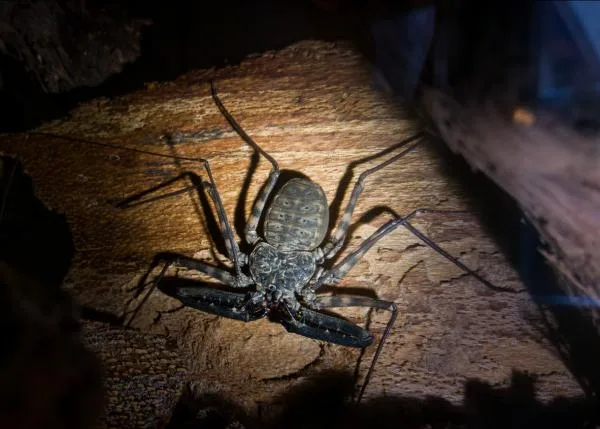
They do not show up every night, but sometimes they are seen. We watch them calmly and from a distance, and never touch them.
One of the favorite stops: brightly colored poison dart frogs, which we look for along the trail.
Those colors are a warning to animals that might eat them: "I am poisonous". We look and take photos, but never touch.
Insects that you never see by day come out at night, like stick insects, so similar to a branch that they would go unnoticed without the guide.
At the foot of the big trees we look for them in their holes in the ground. We watch them by flashlight, without touching them.
You sleep in a private room with a private bathroom, fan and electricity.
We leave by boat from the Puerto Nariño pier and cross the Amazon River from Colombia to Peru.
Pink and grey dolphins can also be seen in the middle of the river: they come and go all over this part of the Amazon.
They are wild animals, so sightings are never 100% guaranteed.
We step ashore in a community on the Peruvian side. From here the walk to look for sloths begins.
From the community we explore the island in Peru, between the forest and the lakes, where the sloth-spotting points are.
In high water the island is flooded, so we do the same route by boat.
We look for them high in the trees, especially cecropia trees near the lakes. From below they look like a ball of fur among the branches: your guide shows you how to spot them.
A sloth spends almost its whole life hanging from branches. It eats leaves, which give it little energy, so it moves slowly and sleeps many hours a day.
It can turn its head a long way to reach leaves without moving from its spot.
Tiny algae grow in its fur, giving it a greenish tint that helps it blend in with the leaves.
It comes down to the ground about once a week and, believe it or not, it is a good swimmer.
We follow the shores of the island lakes and channels, another place where sloths and other animals are seen.
We finish the walk back at the community.
Traditional food and cultural exchange before we head back to Puerto Nariño.
From Puerto Nariño we leave by boat and go up a dark-water creek, through the jungle, to the Tikuna indigenous community of Paraíso.
We reach the Tikuna community of Paraíso, where they welcome us to see their territory. When the visit ends we return along the same creek to Puerto Nariño.
We reach the Tikuna community of Paraíso, which welcomes us as guests. The Tikuna are one of the largest indigenous peoples of the Amazon and have their own language, which is still taught to children.
They are known for their chambira fiber crafts, their bark masks and the Pelazón, the ritual in which girls become women.
The maloca is the great traditional house of the Amazon peoples: tall, made of wood, with a palm-leaf roof that reaches almost to the ground.
Inside it is cool and spacious. It is the meeting place of the community, where stories are told and ceremonies are held.
We walk through primary forest, forest that has never been cut: tall old trees, shade almost all the time and a huge number of species.
Along the way the community shows us medicinal plants and what they are used for, knowledge that passes from generation to generation.
We reach a lupuna, as the ceiba is called in the Amazon: it can pass 50 meters and stands on roots as wide as walls. Next to it you feel small.
For many Amazon peoples it is a sacred tree that joins earth and sky. Plants, insects, birds and monkeys live on its trunk and branches.
We finish the walk back at the community.
We return to Puerto Nariño for dinner and a second night in your private room.
From Puerto Nariño we go by boat up a dark-water channel to Lake Correo, in the Tarapoto wetland.
In high water the river floods the forest and the pink and grey dolphins move into the lakes. We tour Lake Correo slowly, from one bank to the other, to watch them surface to breathe.
We also fish for piranhas the way it is done in the Amazon: a handmade wooden rod, line and meat as bait, with your guide beside you; the piranhas are released. In high water you catch fewer than in low water, because the fish have more room.
Along the way your guide shows you the birds that live on the lake banks.
We return to Puerto Nariño along the same channel.
From Puerto Nariño we kayak toward the forest that the river covers with water when it is high.
In high water the river rises, enters the forest and the land trails go under water. That is why you can paddle between the trunks and the treetops.
We only do it in high water: from late January to early June, with the most water around April. In low water the river drops and there is no kayaking.
The kayak moves quietly, without a motor, which helps you see the birds of the flooded forest without scaring them. Your guide shows you where to look.
We finish the trip back in Puerto Nariño.
A last local meal before the boat back to Leticia.
After lunch we say goodbye to Puerto Nariño and take the public boat back, downriver on the Amazon. The usual boat leaves at 3:30 p.m.
Flying the same evening? Tell us when you book: we take the 1:30 p.m. boat instead.
The 3:30 p.m. boat reaches Leticia around 5:00 p.m.; the 1:30 p.m. boat around 3:00 p.m., with the transfer to the airport. The exact time depends on the river.
Scroll down: the map changes with every activity.
Day 1 · Midday
Interactive illustrated map of the public boat ride from Leticia to Puerto Nariño. Not to scale.
Day 1 · Afternoon activity
Activity: Jungle walk and forest reserve visit
Interactive illustrated map of the jungle walk and the reserve. Not to scale.
Day 1 · Night activity
Activity: Night jungle walk
Interactive illustrated map of the night walk. Not to scale; these are wild animals and every night is different.
Day 2 · Morning
Activity: Crossing from Colombia to Peru
Interactive illustrated map of the crossing from Colombia to Peru. Not to scale.
Day 2 · Morning activity
Activity: Sloth watching
Interactive illustrated map of the island walk to see sloths. Not to scale; these are wild animals, so sightings are never 100% guaranteed.
Day 2 · Afternoon
Activity: Boat to the Tikuna community of Paraíso
Interactive illustrated map of the boat ride to the Paraíso community. Not to scale.
Day 2 · Afternoon activity
Activity: Visit to the Tikuna community of Paraíso
Interactive illustrated map of the walk with the Paraíso community. Not to scale.
Day 3 · Morning activity
Activity: Pink dolphin watching
Interactive illustrated map of the pink dolphin route on the Amazon River in low water. Not to scale; these are wild animals, so sightings are never 100% guaranteed.
Day 3 · Second morning activity
Activity: Piranha fishing and lake visit
Interactive illustrated map of the piranha fishing trip to Lake Correo. Not to scale.
Day 3 · Back to Leticia
Interactive illustrated map of the public boat ride back from Puerto Nariño to Leticia. Not to scale.
When you land in Leticia we meet you at the airport, take care of your bags and start the tour right away.
The route is built for morning flights: if you land after 12:20 p.m., you sleep in Leticia and leave at 7:00 a.m. the next day.
If your flight lands around 8:00 or 9:00 a.m., we make a city tour of Tabatinga, the Brazilian town next to Leticia, before the boat, so you start the trip with a visit to a second country. If you land later, there is no Tabatinga tour: we go straight to lunch and then to the 2:00 p.m. boat.
With the 12:00 boat, we have lunch around 11:00 a.m., right after the city tour. If you land later, we have lunch first and then go to the 2:00 p.m. boat without rushing.
We go to the port and take the public boat to Puerto Nariño, upriver. It leaves at 12:00 p.m. if you landed around 8:00 or 9:00 a.m., or at 2:00 p.m. if you landed later but before 12:20 p.m.
The trip between Leticia and Puerto Nariño is on the public boat, on its regular route, shared with other passengers. From Puerto Nariño on, the tour activities run on our own boats.
When the water is low we walk across an island to reach the boat; in high water we board directly in Leticia. The boat takes about 2 hours.
From here the tour moves into slower river routes, small settlements and wildlife zones.
From Puerto Nariño we walk through terra firme forest: higher ground than the river that does not flood, even at high water.
It is a forest in layers: leaves on the ground, palms and shrubs in the middle, a canopy roof above and giants that rise over it. Fallen leaves break down quickly with fungi and insects: the forest feeds itself.
We look for wildlife, especially monkeys. The one seen most often is the squirrel monkey: it weighs under a kilo, has a white face with a black muzzle like a mask, and orange-yellow legs.
It moves in big groups through the treetops: you almost always hear them before you see them. Birds, insects and frogs can also appear.
This is the tree we talk about most: the ceiba, also called lupuna in the Amazon. It can pass 50 meters and stands on buttress roots as wide as walls: next to it you feel small.
Its flowers open at night and are pollinated by bats. For many Indigenous peoples it is a sacred tree that joins the earth with the sky.
In the reserve we see the giant water lily (victoria regia), the largest aquatic plant in the world: floating leaves with a raised rim like a tray, more than two meters across. Its flower opens white and later turns pink.
In the same lagoon the pirarucu, one of the largest river fish in the world, sometimes comes up to the surface to breathe.
We return to town to have dinner and get ready for the night walk.
After dark, with a flashlight and your guide, we go out to see what moves in the forest.
They do not show up every night, but sometimes they are seen. We watch them calmly and from a distance, and never touch them.
One of the favorite stops: brightly colored poison dart frogs, which we look for along the trail.
Those colors are a warning to animals that might eat them: "I am poisonous". We look and take photos, but never touch.
Insects that you never see by day come out at night, like stick insects, so similar to a branch that they would go unnoticed without the guide.
At the foot of the big trees we look for them in their holes in the ground. We watch them by flashlight, without touching them.
You sleep in a private room with a private bathroom, fan and electricity.
We leave by boat from the Puerto Nariño pier and cross the Amazon River from Colombia to Peru.
Pink and grey dolphins can also be seen in the middle of the river: they come and go all over this part of the Amazon.
They are wild animals, so sightings are never 100% guaranteed.
We step ashore in a community on the Peruvian side. From here the walk to look for sloths begins.
From the community we explore the island in Peru, between the forest and the lakes, where the sloth-spotting points are.
In low water the trails are firm, so we do the route on foot.
We look for them high in the trees, especially cecropia trees near the lakes. From below they look like a ball of fur among the branches: your guide shows you how to spot them.
A sloth spends almost its whole life hanging from branches. It eats leaves, which give it little energy, so it moves slowly and sleeps many hours a day.
It can turn its head a long way to reach leaves without moving from its spot.
Tiny algae grow in its fur, giving it a greenish tint that helps it blend in with the leaves.
It comes down to the ground about once a week and, believe it or not, it is a good swimmer.
We follow the shores of the island lakes and channels, another place where sloths and other animals are seen.
We finish the walk back at the community.
Traditional food and cultural exchange before we head back to Puerto Nariño.
From Puerto Nariño we leave by boat and go up a dark-water creek, through the jungle, to the Tikuna indigenous community of Paraíso.
We reach the Tikuna community of Paraíso, where they welcome us to see their territory. When the visit ends we return along the same creek to Puerto Nariño.
We reach the Tikuna community of Paraíso, which welcomes us as guests. The Tikuna are one of the largest indigenous peoples of the Amazon and have their own language, which is still taught to children.
They are known for their chambira fiber crafts, their bark masks and the Pelazón, the ritual in which girls become women.
The maloca is the great traditional house of the Amazon peoples: tall, made of wood, with a palm-leaf roof that reaches almost to the ground.
Inside it is cool and spacious. It is the meeting place of the community, where stories are told and ceremonies are held.
We walk through primary forest, forest that has never been cut: tall old trees, shade almost all the time and a huge number of species.
Along the way the community shows us medicinal plants and what they are used for, knowledge that passes from generation to generation.
We reach a lupuna, as the ceiba is called in the Amazon: it can pass 50 meters and stands on roots as wide as walls. Next to it you feel small.
For many Amazon peoples it is a sacred tree that joins earth and sky. Plants, insects, birds and monkeys live on its trunk and branches.
We finish the walk back at the community.
We return to Puerto Nariño for dinner and a second night in your private room.
From the Puerto Nariño dock we set out by boat, everyone wearing a life jacket, to tour the Amazon River in front of the town.
In low water the dolphins feed in the big river, so we look for them here.
It is the largest river dolphin in the world, and its pink color gets deeper with age.
Its neck is flexible and it can turn its head to look for fish among the banks and the logs.
When the river drops, the fish gather in the main channel and the dolphins come out to the big river to hunt them. That is why they are easier to see here in low water.
These are wild animals, so sightings are never 100% guaranteed. We watch them with respect and never disturb them.
In low water the river uncovers sand beaches in the middle of the water. We stop at one for a swim in the Amazon.
We return to the Puerto Nariño dock.
From Puerto Nariño we go by boat up a dark-water channel to Lake Correo, in the Tarapoto wetland.
We fish the way it is done in the Amazon: a handmade wooden rod, line and meat as bait, with your guide beside you. The piranhas are released.
Their teeth cut like scissors, but they almost never attack people. In low water you catch more: the water drops and the fish stay together.
Besides fishing, we tour the lake by boat to watch birds and any wildlife we can find along its forest banks.
It is a calm, dark-water landscape, very different from the big river.
We return to Puerto Nariño along the same channel.
A last local meal before the boat back to Leticia.
After lunch we say goodbye to Puerto Nariño and take the public boat back, downriver on the Amazon. The usual boat leaves at 3:30 p.m.
Flying the same evening? Tell us when you book: we take the 1:30 p.m. boat instead.
The 3:30 p.m. boat reaches Leticia around 5:00 p.m.; the 1:30 p.m. boat around 3:00 p.m., with the transfer to the airport. The exact time depends on the river.
Swipe sideways to see every day →
| Time of day | Day 1 | Day 2 | Day 3 |
|---|---|---|---|
| Morning | Airport welcome and city tour of Tabatinga, in Brazil (flights around 8:00 or 9:00 a.m.) | Boat crossing to a community on the Peruvian side, then a boat route to look for sloths | Lake Correo: pink and grey dolphins, piranha fishing and birds, then kayaking through the flooded forest |
| Midday | Lunch, then the public boat to Puerto Nariño (12:00 or 2:00 p.m.) | Lunch with the community | Last lunch in Puerto Nariño |
| Afternoon | Check-in and a jungle walk to the nature reserve | Boat to the Tikuna community of Paraíso and a walk with the community | Public boat back to Leticia (3:30 p.m., or 1:30 p.m. for an evening flight) |
| Night | Night walk looking for tarantulas, then a private room to rest | Back in Puerto Nariño: second night in your private room | - |
| Time of day | Day 1 | Day 2 | Day 3 |
|---|---|---|---|
| Morning | Airport welcome and city tour of Tabatinga, in Brazil (flights around 8:00 or 9:00 a.m.) | Boat crossing to a community on the Peruvian side, then a walk to look for sloths | Pink and grey dolphins on the Amazon River and a swim on a river beach, then piranha fishing on Lake Correo |
| Midday | Lunch, then the public boat to Puerto Nariño (12:00 or 2:00 p.m.) | Lunch with the community | Last lunch in Puerto Nariño |
| Afternoon | Check-in and a jungle walk to the nature reserve | Boat to the Tikuna community of Paraíso and a walk with the community | Public boat back to Leticia (3:30 p.m., or 1:30 p.m. for an evening flight) |
| Night | Night walk looking for tarantulas, then a private room to rest | Back in Puerto Nariño: second night in your private room | - |
| Travelers | Price per person |
|---|---|
| Group of 5+ | COP 1,450,000 |
| 4 people | COP 1,500,000 |
| 3 people | COP 1,600,000 |
| 2 people | COP 1,700,000 |
| Solo (private room) | COP 1,750,000 |
Prices in COP per person for 3 days and 2 nights, the same in high and low water. Local fees are paid separately, once: COP 50,000 per person in Leticia and COP 30,000 per person in Puerto Nariño. Shared tours take up to 6 travelers; any group size can book a private tour (add COP 250,000 per person). No deposit: you pay when you arrive. Card has no extra fee, and cash saves COP 50,000 per person. Free date changes if you tell us at least 2 days before. If the river changes before your tour, we tell you and run the version that fits the water, at the same price.
Booking request
Send your dates, flight timing and group size. We will reply with availability, the best-fitting route and the next step to confirm.
Not included: local fees (COP 50,000 per person in Leticia and COP 30,000 per person in Puerto Nariño), drinks other than water, and activities outside the itinerary.
Swipe sideways to see all 3 photos →


The same private room with private bathroom, fan and electricity in Puerto Nariño for both nights. Solo travelers also get a private room.
Full-board local meals with fish, chicken or regional dishes, from lunch on day 1 (before the boat) to lunch on day 3. Vegetarian, vegan and allergy-aware meals on request, if you tell us in advance.
This tour starts the day you land. A flight around 8:00 or 9:00 a.m. fits the 12:00 p.m. public boat: we meet you at the airport, make the city tour of Tabatinga, have lunch and take you to the boat. If you land later but before 12:20 p.m., we have lunch and take you to the 2:00 p.m. public boat, without the Tabatinga tour. If you land after 12:20 p.m., sleep in Leticia and take the 7:00 a.m. tour the next day. On day 3, after the last lunch in Puerto Nariño, the public boat leaves at 3:30 p.m. and reaches Leticia around 5:00 p.m. If you fly that evening (for example the 5:50 p.m. Avianca flight), we take the 1:30 p.m. boat, reach Leticia around 3:00 p.m. and take you to the airport. Send us your flight times when you book.
The route starts soon after you land, so keep your passport, repellent, water and one change of light clothes in a small bag on day 1.
Compare the 3 day tour options (next day or same day) → The 3 day tour that leaves at 7:00 a.m. the day after you arrive → Plan your trip to Leticia: costs, flights and dates → The regular 2 day tour in Leticia → Tour prices by group size → 2 vs 3 vs 4 days: which one to choose →
Yes, if you land in the morning. A flight around 8:00 or 9:00 a.m. fits the 12:00 p.m. public boat: we meet you at the airport, make a city tour of Tabatinga, in Brazil, have lunch and take you to the boat. If you land later but before 12:20 p.m., we have lunch and take you to the 2:00 p.m. boat, without the Tabatinga tour. If you land after 12:20 p.m., sleep in Leticia and take the 7:00 a.m. tour the next day.
We meet you at the airport, make a city tour of Tabatinga (flights around 8:00 or 9:00 a.m.) and have lunch. Then the public boat takes about 2 hours to Puerto Nariño. After check-in you walk through the jungle to the nature reserve to look for giant water lilies and pirarucu, and at night you do a night walk looking for tarantulas.
Only the last morning (day 3), and how we look for sloths in Peru on day 2. In high water (late January to early June) day 3 is Lake Correo for dolphins, piranha fishing and birds, then kayaking through the flooded forest. In low water (late June to early January) day 3 is pink dolphins on the Amazon River with a swim on a river beach, then piranha fishing on Lake Correo. The price and the rest of the route are the same.
We tell you and we run the version that fits the water on your days. The price does not change.
No. The trip between Leticia and Puerto Nariño is on the public boat, on its regular route, shared with other passengers. The tickets are included in the price. Private boats are only the ones we use for your tour activities in and around Puerto Nariño.
This one is for travelers who land in the morning and want to start the same day, so day 1 has the Tabatinga city tour and the boat to Puerto Nariño. The 7:00 a.m. tour is for travelers who arrive the day before; its day 1 has a morning activity (kayaking or piranha fishing, by the water level). Days 2 and 3 are very similar.
Day 3 has two morning activities, a last lunch in Puerto Nariño and the public boat back to Leticia. The usual boat leaves at 3:30 p.m. and arrives around 5:00 p.m. If you have an evening flight, such as the 5:50 p.m. Avianca flight, we take the 1:30 p.m. boat, arrive around 3:00 p.m. and help you with the transfer to the airport. Tell us your flight when you book.
Very likely, but they are wild animals, so it is never 100% guaranteed. In high water they move into the lakes, so we look for them on Lake Correo. In low water they are in the big river, so we look for them on the Amazon River in front of Puerto Nariño. If we do not see them on the first trip, we look in another area the same morning.
It rains for about an hour on most days, and the tour goes on: we lend you rubber boots and a rain cover. If the weather is dangerous, we change the order of the activities or wait for it to pass.
The same private room with private bathroom, fan and electricity in Puerto Nariño for both nights, plus local meals from lunch on day 1 (before the boat) to lunch on day 3: fish, chicken or regional dishes. Vegetarian, vegan and allergy-aware meals are available if you tell us in advance.
Shared tours take up to 6 travelers, and the price per person depends on how many people are in your booking. For a private tour, add COP 250,000 per person. Any group size can book a private tour.
Send us your dates and your flight time on WhatsApp and we confirm availability. There is no deposit: you pay when you arrive, by card (no extra fee) or in cash (COP 50,000 off per person).
Google 4.6/5 from 105 reviews. Tripadvisor 4.7/5 from 271 reviews.
“Unforgettable experience in a virtual utopia of ecotourism. All details arranged… It exceeded all expectations and was worth every penny.”
Aaron Dushku
Google review · February 2026
“Awesome service. Had only the time to do the two day tour, but it was so worth it. Alex was an excellent tour guide!”
Nyulas Márton
Google review · July 2026
“Well organized tour, lifetime experience. Highly recommend!”
János Takács
Google review · July 2026